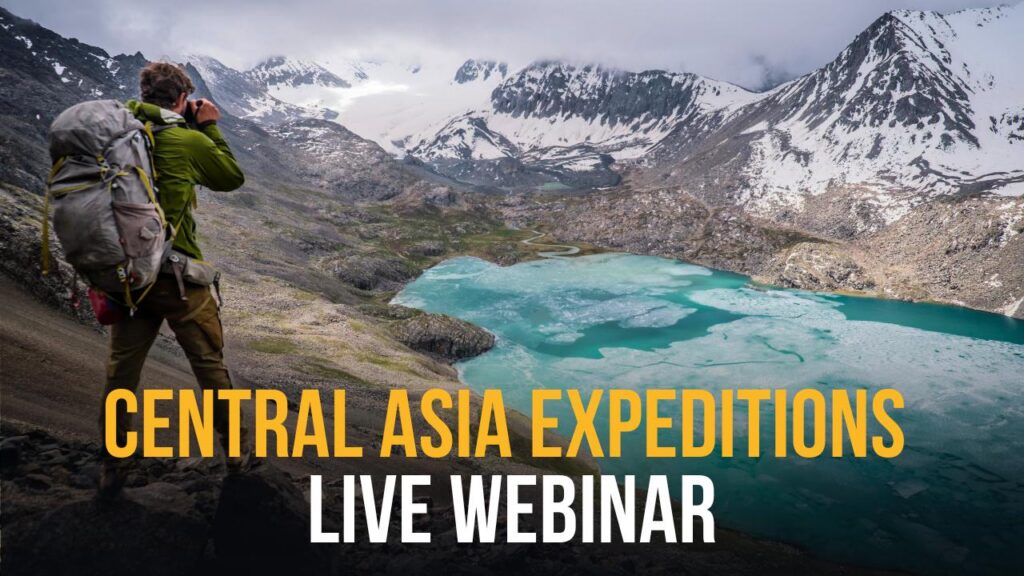
The following is a video recording and transcript from a webinar hosted on May 2, 2026, by Epic Expeditions.
Video Recording

Transcript
My name is Chris Lininger. I’m the founder of Epic Expeditions. Today, we’re going to be walking through all of our Central Asia programs to give you a good idea of the trips we have going on in this very interesting part of the world. Feel free to settle in, grab a coffee, and we’re going to go on a bit of a journey through Central Asia here together.
Can everybody see my screen? Great.
What we’re going to cover in this webinar is the four unique Central Asia itineraries that we have going on. They’re all quite different. We’re going to highlight what makes each trip special, the difficulty level, why we love Central Asia — why I personally love it and why the Epic Expeditions brand and our entire team loves this part of the world — the safety situation in Central Asia, and the live Q&A at the end.
Just a reminder: we have Ralph Cope, the director of Epic Expeditions, in the chat collecting your questions. I’ll do a live Q&A at the end, so feel free to drop any questions into the chat and I will do my best to get through as many as we can.
Some of you might not know about Epic Expeditions, or you’re new to us. Some of you have traveled with us one, two, three, five times before. For those of you who are new to Epic Expeditions: we are a small company that was founded in 2018. We initially started running trips in Pakistan that year, and for the first few years of operation that was the only place where we were running trips.
In 2019, we started doing scouting trips to Central Asia — Kyrgyzstan specifically. There’s a photo of me and Epic director Ralph Cope at Ala-Kol Lake in Kyrgyzstan in 2019, on our whirlwind multi-region, planes-trains-and-automobiles style travel all around that country. We absolutely fell in love with Kyrgyzstan and Central Asia, and we have been coming back pretty much every year since. Over the years we’ve expanded our operations to the neighboring countries of Uzbekistan and Tajikistan, as well as Mongolia.
What I’m particularly proud of with these itineraries is that they are quite unique — itineraries you won’t necessarily find anywhere else, with the attention to detail with cultural elements baked in, as well as some of the longer trekking itineraries which I’ll get into shortly. That is essentially our condensed history of our work in Central Asia.
And if you’re new to Epic, welcome.
So why Central Asia?
There’s a lot to love in Central Asia. There are several major mountain ranges in this part of the world: the Tian Shan range, the Pamir range, the Altai mountain range, and also the edges of the Himalaya and the Karakoram, which are in the far corners of what we would consider Central Asia.
In recent years — and it depends on the country — tourism has picked up, but it’s still not overly commercialized or super busy. The locals we interact with or encounter on the itinerary are just there living their lives. They’re happy to see visitors come through, but it’s not a staged, commercial vibe in most of Central Asia, which I really love.
The ancient traditions are still very much alive. I’ll briefly touch on the impact that the Soviet Union had on this part of the world, because all of the countries we’re going to talk about today were part of the Soviet Union until the fall in 1991. Mongolia officially was not, but unofficially it very much was — they had a communist government for that 80-year period. They were under the thumb of Moscow, and part of the communist program was to try to suppress all of the traditions and the nomadic lifestyle. Thankfully, a lot of it survived, and there has been a real revival since the fall of the Soviet Union, which we can see and feel today.
As I mentioned: little to no crowds. It does depend on where you go because some areas are popular. But in general, this part of the world is pretty free from mass tourism, which is why we are there.
Places like Mongolia and other Central Asian nations may not have a great reputation when it comes to food, but I find that to be really incorrect. The food — especially in Uzbekistan and Kyrgyzstan — is just incredible. Many centuries of culture, millennia essentially of really strong culinary tradition. And the cities of Uzbekistan, for example, are some of the most impressive, historically intact places you will ever see. That ties together the culture, the trekking, and the adventure. And if you like taking photos — most of these slides are photos I’ve shot over the years — this part of the world is a photography paradise. If the food and landscapes weren’t enough, if you like taking photos, you’re going to love Central Asia.
Over the years we’ve had five itineraries total. Currently we are running these four, and these are the ones we’re going to talk about. We actually just yesterday did a soft launch of a new trip happening in 2027 — if you like to climb high things, this is a trip you’ll be interested in. But I’m not going to talk about that one too much right now.
We have two itineraries in Kyrgyzstan, then a hybrid two-country itinerary where we hit Tajikistan and Uzbekistan, and of course our Mongolia program. I’ll be touching on all four during this presentation. If you have any questions about specifics I don’t cover, please drop a note in the group chat.
An important thing to understand — and I appreciate this isn’t the best map, but bear with me — most people probably couldn’t find some of these countries on a map. For those of you who didn’t study up beforehand, this is the general geography of the region known as Central Asia. Both for historical and modern significance, we have two of the big powers: to the north, Russia, and to the south, China. These have had major influences over the centuries. You can see Mongolia in the far east, and then the concentration of Kyrgyzstan, Tajikistan, and Uzbekistan. And even further back in the past, to the southeast, you had the former Persian Empire. This area is steeped in significant world history. It was the center of the world when the Silk Road was at its height. Of course, we will talk more about this in the Mongolia section — the Mongol Empire, the biggest empire that has ever existed. This is the general geography, so you know where in the world these places are.
Let’s get into Kyrgyzstan.
Kyrgyzstan was the first place we went in Central Asia and where it all began for us. A few fun facts: pretty small population — 7 million. It remains an important Silk Road crossroads, and of the immediate neighboring Stan countries, Kyrgyzstan still has the strongest nomadic heritage with people living that lifestyle today. It also has the highest mountains in the region — the Tian Shan and the southern Pamir ranges.
There are 101 reasons to love Kyrgyzstan, but it’s the raw, untouched character — so many awesome hikes, climbs, treks — combined with a really strong nomadic culture, that is why we love it.
Here is the Osh and Koshoi Valley trip.
Ironically, this is a trip we’re rolling out for the first time this year, but it was first scouted by myself and Ralph Cope in 2019. It remains to this day one of the most impressive multi-day treks I’ve ever done. We held off launching it back then because we wanted to develop other trips that were a bit shorter or easier while we were still figuring things out. Now, seven years later, we are so excited to finally be launching this trip.
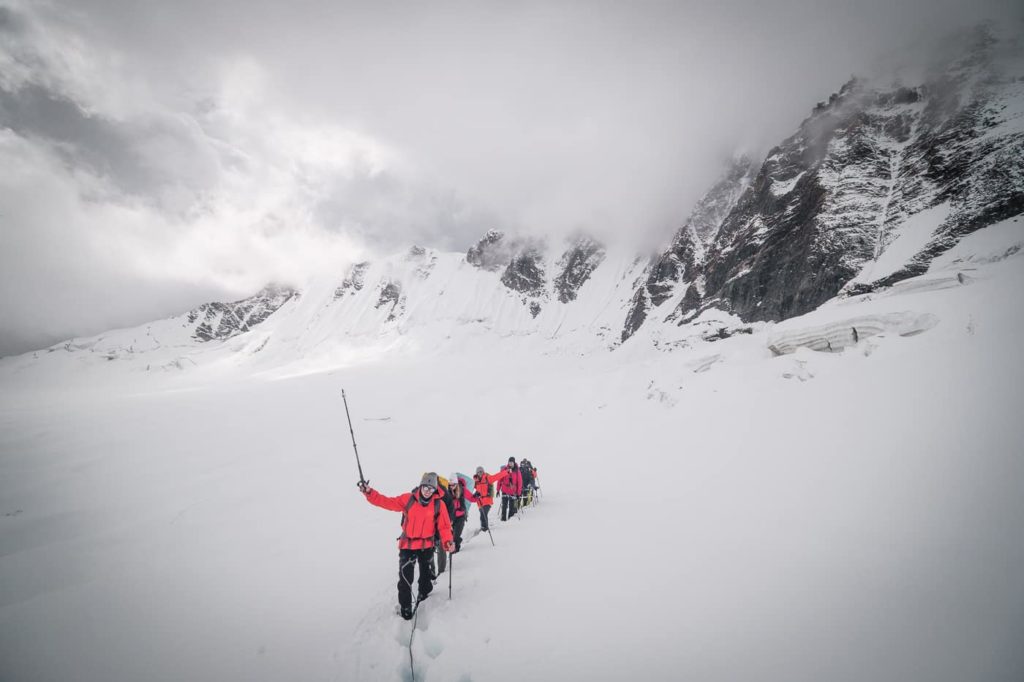
We have a trip happening there this July. Of all the trips I’m talking about today, this one is the most physically challenging. You’re out camping for nine nights in an area in southern Kyrgyzstan that is totally wild — no permanent human settlements out there. It has earned the nickname from the climbing and adventure community of “the Patagonia of Central Asia” or “the Yosemite of Central Asia,” because the landscapes are on that level of impressiveness.
This trip is approximately 110 kilometers spread over nine days. The Yosemite comparison comes from the major rock climbing here — huge granite walls, incredible valleys with mountains all around.
On the epic scale, if you’re looking for a big adventure that is physically challenging but has all the elements of big mountains, remote terrain, and very few people, this is probably the trip you want. If you’ve been with us to K2 base camp, I wouldn’t say it’s quite the same level of remoteness, but you get there in a different way.
As far as I know — and something I’m extremely proud of, and I know Ralph is too — we are the only company running this trip. The only especially western international company. That alone should tell you it’s not on a lot of people’s radar, and there’s a lot to look forward to. We already have our 2027 dates up. This trip is basically full for this summer — I think we may still have one spot left if you’re interested. But yeah, this is an awesome trip. If you love hiking and remote environments, this is one I can highly recommend.
The second Kyrgyzstan trip we’re doing this year is the World Nomad Games. This is a very different trip — really a cultural and event-focused experience. If you don’t know what the World Nomad Games are, I’d describe it as the Olympics of nomadic sport. There’s a sport called Kok-Boru, for example, which is a cross between horseback riding, rugby, and polo — but the ball is a goat carcass, and people wrestle to put it in a goal. It’s a very interesting cultural event that only happens every two years, and the host country changes each time. In the past it’s been in Kazakhstan and Turkey. The original one several years ago was in Kyrgyzstan, and now it’s back.
We probably won’t be running this trip year after year — it depends on how this one goes and where the next host country is. But because it’s in Kyrgyzstan, the land of the nomads and a place we really love, we’re excited about running it.
Some of the other sports include archery competitions, eagle hunting, wrestling, and other fascinating events like Kok-Boru, all held in a big stadium. What’s also really cool is that athletes come from all the neighboring countries. I still don’t know how, for example, the guys from Mongolia get their eagles there. Some of them actually ride horses all the way from various places, and others apparently fly with their eagles.
This trip is primarily cultural. There’s not a lot of hiking involved — a few little day hikes, but no camping. It’s hotel and yurt stays, enjoying the event, and then we head up to the Issyk-Kul Lake area to spend time exploring that very beautiful part of Kyrgyzstan, staying in yurts and road-tripping around combined with day hikes. We’re really looking forward to it.
Moving on to the second trekking-focused program: Tajikistan and Uzbekistan.
Very different countries from Kyrgyzstan. Uzbekistan is quite flat and dry, while Tajikistan is quite mountainous — similar to Kyrgyzstan. Uzbekistan was at one time among the most important regions in the world during the height of the Silk Roads. This was a major crossroads with enormous wealth — think of it almost as the Silicon Valley of the ancient world: Samarkand, Bukhara, etc.
This trip is very cool in the sense that it really delivers on both the culture and the trekking — more so than any other trip on this list. The trip starts in Uzbekistan, where you get to explore Samarkand. Then you cross the border and do some hiking, trekking, and camping for a week. Then you come back and check out another Silk Road town, Bukhara.
The primary focus is the Fan Mountains of Tajikistan — another major mountain range. I led a trip here a few years ago, and the group was so much fun. We had great weather. Similar to the Koshoi Valley trip, you’re out for eight nights in very wild, remote country that doesn’t have any villages except on the outskirts of where the trek takes place.
A major highlight for me is that at pretty much every campsite you visit one of these beautiful alpine lakes. You do your trekking day and finish at a stunning alpine lake. This trip could be called “The Fan Mountains Lake Trek,” because that’s really what it feels like.
You also get into really interesting alpine environments when you cross the Chimtarga Pass — from memory, around 4,750 meters or about 15,500 feet — so you do get some altitude exposure. After the pass, you have a few more days of trekking, then head back across to Uzbekistan to enjoy Bukhara, eat, shower, and do all the things.
This trip is for people who have an interest in history — the Silk Road, the Mongol history. And actually a unique aspect of Samarkand and Bukhara is this: the Mongols basically gave you two options. Join them, or have your entire civilization burned to the ground. Because the people in charge in Samarkand for the most part agreed, everything is preserved. They’ve also taken a lot of care to restore UNESCO World Heritage Sites there — unlike places in modern-day Iraq, for example, that were totally flattened by the Mongols because they did not choose option A. It’s a really special thing to see what many parts of the ancient world looked like before the Mongol invasion, and to find it still alive and intact and also a functioning modern city. So that’s the Fan Mountains trip.
Moving on: Mongolia.
Mongolia has, over the last three years, risen to become our most popular program. It is the largest country in our Central Asian lineup. It’s a very big country with a small population, because a lot of Mongolia is just stepland — rolling prairie and hills. But in the far western corner, you have the Altai mountain range, which is where our trip takes place.
We first started this trip in 2023, and as I said, it is now one of the most popular programs at Epic. And for good reason. It has a little bit of everything. I’d say it has less Silk Road history and more local culture interactions — homestays, cultural festivals. Mongolia is one of those places in history that needs no introduction: the biggest empire in the world. The influence of the Mongols — culturally, genetically — is staggering. They say something like one in 200 males from European ancestry has Mongol DNA, which tells you how far the Mongolian influence and empire stretched.
There’s a lot to take in in Mongolia, and it’s a country I look forward to returning to every year. We have three groups going there this year and I’m leading two of them.
We’re going to the Altai Mountains. That’s probably not what you picture when you think of Mongolia — you probably think of wide-open grasslands with nothing around. And yes, Mongolia has plenty of that. The steppe is referred to as an ocean of grass. That’s actually how Genghis Khan and his army were able to support all of their troops — basically endless grass buffet for animals. But in western Mongolia, the only major mountain range — the Altai — exists, and that’s exactly where we are headed.
Another major component of the Altai Mountains trip is that we have horses with us. The goal is very much optional: if we have 12 participants, we bring roughly six horses, and people can take turns riding and hiking. This has worked really well and adds a fun element. Mongolia is the land of the horse. If you want to channel your inner Lord of the Rings vibe and ride across the epic Altai steppe landscape, Mongolia is the place.
The camping, trekking, and horse phase of this trip is about a week. The trip starts in Ulaanbaatar, we fly to the other side of the country, and the majority of the trip takes place in Tavan Bogd National Park. The Tuvan people are an ethnic group in this part of Mongolia who lead a nomadic lifestyle for part of the year and live in the national park. We have some interactions with them out there. They also manage the camels that carry all our gear from camp to camp.
Major highlights: the homestay with a local eagle hunter family. We stay at their summer grazing property — something their family has been doing for generations. We get to spend a night with them, see how they live, ask them questions, and have a private eagle hunting demonstration, plus of course put on their incredible traditional clothing. That’s a major highlight for me.
The whole time in the Altai, it’s pretty rare to see other groups, especially at the time of year we go — it’s the shoulder season for trekking. In addition to the Tuvan people, there are also many Kazakh-speaking nomadic peoples in the area.
The grand finale of the trip is the Golden Eagle Festival, which only happens in September and October each year. This is what also makes this trip very special. It ticks all the boxes: you stay with a local eagle hunter family, attend the Golden Eagle Festival at the end, and do the trek in the middle. It’s pretty obvious why this trip is so popular.
If you haven’t been to Mongolia — and even if you have, since a lot of people only go to the Gobi Desert or stay near the capital, Ulaanbaatar — this is an amazing bucket-list trip. The combination of local interactions, horses, and hiking makes it a complete experience. We’ve had some incredible groups there over the years, and it’s an itinerary we are very proud of.
So, there are a bunch of different types of accommodation depending on the trip. For those of you who don’t know what a yurt is: it is the original nomadic house that has been a functional piece of shelter across the steplands for thousands of years, and people are still using them. Most trips — with the exception of the Fan Mountains trip — involve staying in or seeing yurts throughout. In Kyrgyzstan, you can’t really drive down the road without seeing them; they even put them in cities.
The accommodation across our trips is quite diverse. Sometimes we’re doing full expedition camping with a mess tent, cooks, and individual tents. Sometimes we’re staying with a local family, or in a yurt adjacent to a local family. In cities it’s guesthouses and hotels with showers and Wi-Fi. Where we stay has always been very important to me — it is something we pay a lot of attention to, and I believe it contributes deeply to the overall travel experience.
Is Central Asia safe?
I’ll start with the “Stan’s myth.” A friend of mine who is an officer in the United States Navy, when I mentioned the Kyrgyzstan trip to him, said: “I am very suspicious and skeptical of anything ending in -stan. If a country ends in -stan, I probably don’t want to go there.”
My first reaction: I think a lot of people share his view. My other reaction: good — in one way — because it means mass tourism doesn’t go to places that only have a perceived bad reputation because of their name. These Central Asian countries don’t have bad reputations, but when people hear “-stan,” they think of Afghanistan and assume all such countries are unsafe.
But on the other hand, a founding principle of Epic Expeditions has always been to use our platform and our trips to break down negative Western stereotypes about these countries. It has been our mission to show people what they’re really about.
Central Asia is one of the most stable and secure places in this region. All of the places we travel to are extremely safe. A big part of that is a strong cultural emphasis on hospitality — caring for guests is a big part of the culture and of Islamic tradition in the region. Violent crime toward foreigners is pretty much unheard of. Petty crime and pickpocketing — you’re much more likely to get pickpocketed in Paris, London, or New York City than in Bishkek or Samarkand. I guarantee that. And though these countries have some neighbors who can flex and from time to time get mixed up in international geopolitical struggles, the countries we specifically visit are stable and safe. They also have pretty predictable weather patterns for trekking and climbing. All of that, combined with growing tourism infrastructure, means I can say with confidence that this is one of the safest regions we visit. The concerns about pickpocketing or personal safety that you’d have in a major Western city simply don’t apply here to the same degree.
This is a personal summary of what I fell in love with in Central Asia.
Food: if you’re a foodie, pretty much every one of these itineraries is going to be a great experience.
Wild spaces: this is not a tagline or a marketing ploy — it is the reality. There are a lot of untouched places in Kyrgyzstan, Tajikistan, Mongolia, and Uzbekistan that showcase the magic of these mountains. What I love about them is that they’re wild and challenging to get to. The Alps are beautiful. The Andes are beautiful. The Himalayas are beautiful. But the Central Asian mountains and trekking routes have so much less foot traffic that it’s really hard not to love the combination of beauty, remoteness, and insulation from mass tourism. I think year after year the secret is slowly getting out, but for now the tourism numbers are vastly less than places like Nepal, Peru, or the Alps. My guess is that in 10 years, these places will be far more popular once more people discover the magic here.
History: I’m a big history person. The Silk Road, the Mongol Empire, the multigenerational reach of the historic legacy of these countries — it is so impressive. A lot of what shaped the world as it is today traces back to events in this region. Visiting the cities and tying all of that history together is something really special.
Nomad culture: there’s something about nomadic peoples that I think is baked into human DNA. The first humans were hunter-gatherers. Today, the vast majority of us live in settled societies — and I love that, too — but there’s something I really connect with in nomad culture that I believe stems from the basic human instinct to move, to be curious, to explore. In these countries, nomadic culture is front and center, still very much alive, and there are many interesting lessons to learn from these people: endurance, perseverance, toughness, adaptability. It’s really meaningful to see their way of life — how they raise their kids, how they survive cold winters, how they’ve built a very strong culture around these concepts.
The list of why I love Central Asia could go on for a long time. But those are the greatest hits.
You’ve probably gathered by now that the locals, the culture, and the history are a big part of these trips.
It’s worth noting that English is not widely spoken, which is why we rely heavily on our local guides to translate. Even when we have interactions with nomadic peoples or eagle hunters, our local translator gives us access to people who otherwise wouldn’t speak English. The lack of English is largely a legacy of the Soviet Union occupying this area for 80 years — English wasn’t taught; Russian was. So even older generation people can speak, understand, and read Russian but not English. It’s also really interesting to see how this region has thrived since the fall of the Soviet Union and the resurgence of all the cultures the Soviets tried to suppress.
All of that — the homestays, the cultural festivals — combined with the trekking means Central Asia really does have it all.
I’m going to wrap up before we move into the Q&A section.
I want to put it out there: we have a 2027 high-altitude climbing trip happening in July of next year. It’s been on my personal bucket list for some years, and it’s not on the website yet. If you’re interested, send us a message. It’s going to be an epic time. Maybe on the next webinar we’ll talk about that one.
I hope you’ve enjoyed this presentation. Central Asia is one of the most impressive parts of the world I can suggest visiting. It’s very different, very diverse, and it is a region we will continue to expand our operations in. We are deeply invested through our local friendships and partnerships there, and we want to bring elite-level trips and go on some fun adventures with you.
All right, let’s get into your questions.
Ralph just sent me some of your questions, so I’ll go through them. Feel free to send in more as I’m going.
Question: What are the logistics of getting to this part of the world from North America?
It depends on where in North America and which itinerary we’re talking about. With the exception of going to Mongolia from the West Coast, you’re pretty much always going to be traveling east — from Eastern Canada, the Eastern United States, or through Europe.
You can get to all of these countries with two stops from most major airports in North America or Europe. The main hubs are Istanbul or the UAE countries (Dubai or Doha).
My first suggestion is Istanbul regardless, because there are direct flights from there to Samarkand and Bishkek. There are also direct flights from many major US, Canadian, and European cities directly to Istanbul.
If you’re going west from the US West Coast, you’d fly to Tokyo or Seoul and then on to Mongolia.
Question: How has the Middle East conflict been affecting flights?
We’re advising people to go through Istanbul. I’m personally going to Pakistan in July and flying through Doha — the UAE. The flights through there to Pakistan have largely continued operating, with maybe the first week or so being the only exception. If there’s uncertainty, Istanbul is the better option. When things are stable, the Emirates are excellent for reaching all these destinations.
Question: What will the weather be like in Kyrgyzstan at the end of August, beginning of September?
I’m assuming this is about the World Nomad Games trip. It’s going to be warm — in the 80s Fahrenheit, I would say. At night it cools down to the 50s and 60s, which is roughly the low 30s or high teens in Celsius. The weather should be fairly sunny. Of course, some rain is possible, but August is considered the drier, summer-type climate. So bring the sunscreen.
Question: Have you ever experienced any dangerous or serious situations in Central Asia?
No, we have not — and that’s the short answer. Perhaps the most serious situation was a dumpling eating competition that nearly put a few people out of commission for a while.
No, it’s a very safe area. Injuries can happen on any trip — people roll an ankle, get blisters — but we’ve never had any major injuries on the record, and we’ve never had any safety or security concerns either.
Question: Are visas straightforward for these countries? Pakistan had a fairly complex process.
It depends on your nationality. Mongolia and Kyrgyzstan: no visa required — you turn up and get approximately 90 days on arrival.
For many nationalities, visa-on-arrival is also available for Uzbekistan and Tajikistan. Because we cross a land border on that itinerary and don’t have a lot of time to spare, we ask everyone to get their visas in advance. The website isn’t the greatest, but visas are typically issued within two days. It’s very fast and doesn’t require a lot of documentation. For the Tajik visa, you’ll need to supply a few addresses of where you’re staying.
By comparison — especially if you’ve done the K2 trip with us, where the trekking and mountaineering visa takes a few months — the visas for these trips are far more forgiving, less time-consuming, and issued in a day or two.
Any more questions? We’ve gone about an hour and I’m quite happy with what we got through.
In summary: there’s a lot to be excited about with Central Asia, and I’m pleased you took the time to see what it’s all about.
Please feel free to email us if you have any questions about the trips, any specifics we didn’t touch on. If you want to sign up or join waiting lists for trips that are currently full, just let us know. You have questions, we’re here to answer them, and we look forward to seeing some of you in this magical part of the world for some adventures soon.
In the meantime: keep training, keep hiking, keep being curious — and we shall meet out there in the world at some point. Take care, everybody. Bye.