The following is an article written by Anthony Lorubbio, Founder and Head Coach at Recal Training.
If you’re preparing or training for a high-altitude trek or hike with Epic, then you’re probably doing all the right things.
Most start by building an aerobic base, doing some strength training, plus muscular endurance training, primarily for your legs. And maybe you’ve even looked into a hypoxic tent. On paper, your preparation looks solid.
Yet, this is where things get interesting — and where most inexperienced trekkers and climbers stop short.
I’ve spent years working with mountain athletes, and I kept seeing the same frustrating pattern: incredibly fit, well-prepared people struggling badly at altitude—sometimes to the point of turning around.
So it begs the question: What if altitude isn’t a fitness problem? What if it’s something else entirely?
This article goes over an often-overlooked part of training for a big climb or trek: remembering to breathe. We’re not here to just remind you, either, but to actually go over proven breathing techniques that will make you perform better in the field.
Effects of Altitude on the Body
Let’s start with the basics: what happens when you arrive at altitude? The issue isn’t that oxygen disappears; it’s that the (barometric) pressure driving oxygen into your system drops.
In other words, as you ascend, each breath delivers fewer usable oxygen molecules into your lungs. Your body senses this immediately and begins to compensate – your breathing rate increases, heart rate rises, nervous system becomes more reactive, etc.
And if that response isn’t well-regulated, things can unravel quickly.
When things go poorly, I often describe this as the Hypoxic Spiral. You start to feel short of breath, so you breathe faster. That faster breathing becomes less efficient, which makes you feel even more breathless. Your system becomes more stressed, not less.
From there, energy drains from your body/mind, fatigue builds, decision-making declines, and what started as a manageable discomfort can turn into a real problem.
Why Breathwork Matters (More Than Fitness Alone)
Here’s the key breakthrough that changed the way smart trekkers prepare for altitude:
Altitude is not just a fitness problem. It’s an oxygen delivery problem.
This matched up with what I saw in the ‘real’ world: you can be incredibly fit, but still struggle if your breathing becomes unstable under stress. I’ve seen it happen more times than I can count.
And on the flip side, I’ve seen people who are not the strongest in the group (or the youngest!) move steadily and successfully because they maintain control of their breathing.
A key metric that research shows can predict – at 90% accuracy – who will show signs of altitude sickness is someone’s hypoxic ventilatory response (HVR)—how effectively your body increases its breathing when oxygen availability drops.
Some people naturally respond well (higher minute ventilation → higher blood oxygen saturation). Many don’t.
But the important part is this: if there’s a problem, your ventilatory response is not necessarily fixed; it must be trained.
How to Breathe Better at High Altitude
Most advice around breathing at altitude is either too vague or too reactive. You’re told what to do when you’re already struggling.
I’d rather you show up prepared.
During training (at home or near sea level), I teach a simple framework: Nose, Slow, and Low (N-S-L):
- Breathing through the nose helps regulate airflow and maintain stability.
- Slowing the breath prevents over-breathing and unnecessary stress.
- Breathing “low” ensures that the diaphragm—not the upper chest—is doing the work.
At altitude, this framework shifts to: Nose, Full, and Low (N-F-L), where we DO want to increase the breathing rate and ultimately minute ventilation.
When breathing shifts into the chest and shoulders, it becomes inefficient. It also becomes more closely tied to your stress response. It can be a downer on a hike that is meant to be enjoyable, but at altitude, it can be a significant problem.
Instead, we want diaphragmatic breathing to be the default. That means the movement of the breath is happening through the lower ribs and belly, not the upper chest. This is what supports better ventilation and more stable oxygen delivery.
If you want to take a free, 5-10 minute assessment to uncover your own bad breathing habits, click here.
After you arrive at altitude, you may also hear about pressure breathing (often referred to as pursed-lip breathing). When used appropriately, this technique can help maintain intra-thoracic pressure and improve oxygen uptake. But like most things, it works best when it’s practiced beforehand—not improvised when you’re already struggling on a steep slope.
You also require stronger expiratory muscles to do ALL of your breathing at altitude, including pressure breathing. Enter: respiratory muscle training.
Respiratory Muscle Training: The Overlooked Limiter
If there’s one area that doesn’t get nearly enough attention, it’s this:
Your breathing muscles fatigue at altitude – even quicker than your legs do.
And when they fatigue, everything else becomes more difficult.
Think about it this way: at higher elevations, the reduced pressure means you have to work harder just to pull air into your lungs. That increases the workload on your diaphragm and intercostal muscles. Now add in the pressure breathing (extra workload for your expiratory muscles).
If those muscles aren’t prepared, they become a limiting factor surprisingly quickly.
This is where respiratory muscle training (RMT) becomes incredibly valuable.
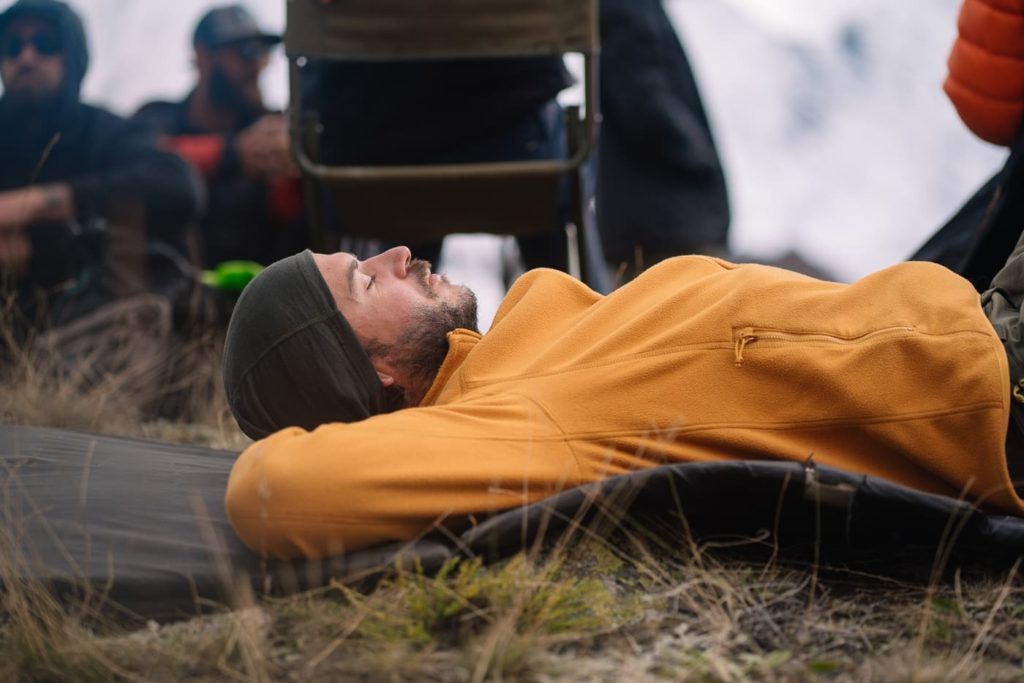
One of the simplest ways I introduce this is through hook-lying diaphragmatic breathing.
- You lie on your back with your knees bent at 90º, feet flat on the ground. From this position, you can add resistance—either with a belt, a weight on the abdomen, or even household items—and focus on strong, controlled inhales driven by the diaphragm.
- Each inhale is intentional and forceful. The exhale, on the other hand, is relaxed. Over time, this builds both strength and endurance in the muscles responsible for breathing.
- From there, we can layer in additional resistance using tools like a SportsMask, or even simply blocking one nostril.
When you reduce airflow and force the body to work harder to breathe, you’re effectively strength training your respiratory system.
And importantly, you’re doing it before altitude demands it of you.
Carbon Dioxide Tolerance and the Feeling of “Air Hunger”
Another piece that’s often misunderstood is what actually drives that feeling of being out of breath. Most people assume it’s a lack of oxygen. In reality, it’s more closely tied to rising levels of carbon dioxide.
When CO₂ builds up, your body sends a strong signal to breathe. If you’re not accustomed to that sensation, it can feel overwhelming. That’s where panic and poor breathing patterns start to creep in.
By training your tolerance to CO₂, you change that experience. You feel less urgency, less panic, and you’re able to maintain control of your breathing even when things get uncomfortable.
This becomes especially valuable on steep terrain, during sustained efforts, or when you’re dealing with cumulative fatigue.
Here’s a training protocol to build your carbon dioxide tolerance:

Where Most Training Plans Fall Short
As I mentioned, most high-altitude trekkers follow a familiar structure (I call this the ‘preparation pie’). They build their trekking fitness, develop strength, and maybe include some altitude exposure. Then they hope their body adapts once they’re on the mountain.
What’s missing is the direct training of the system that is under the most stress: breathing.
When you address that gap, something interesting happens.
You don’t just improve your breathing—you improve the effectiveness of everything else you’re already doing. Your aerobic training becomes more efficient. Your pacing improves. Your recovery between efforts gets faster.
I often describe this as a multiplier effect. You’re not adding more time—you’re getting more out of the time you’re already investing.
Can You Train for Altitude Without Living at Altitude?
This is one of the biggest misconceptions I see. Sure, you aren’t exposing your body to 24/7 ‘real’ altitude – and that definitely should be done during acclimatization.
But you don’t need to live at altitude to begin preparing your oxygen delivery system for altitude.

A hypoxic tent can also help, but it doesn’t fully address the problem. Passive exposure—like sleeping in a tent—doesn’t train your breathing mechanics, your respiratory muscles, or your tolerance to CO₂ in the same way that active training does.
What matters more is how your body responds when stress is applied. And that response can absolutely be trained from anywhere.
Want to Go Deeper?
If you’re reading this and thinking, “This makes sense—but I’m not exactly sure how to apply it,” you’re not alone.
I walk through this in much more detail in a live workshop, where I break down:
- How to assess your own breathing (hint: we incorporate the free Recal Breath Index: assessment.recal.training)
- What specifically to train (and in what order)
- How to integrate it into your existing plan without adding more time
If you want to join our next live webinar, you can register here.
Don’t Forget to Breathe (Seriously)
It sounds simple, I know… But don’t get caught letting your breathing run rampant. Breathe consciously, fully, and with proper breathing mechanics (the ones hopefully you trained beforehand!).
You can do everything else right – the aerobic training, strength, muscular endurance, etc. – and still struggle if your breathing becomes unstable at altitude.
On the other hand, if you can stay controlled, efficient, and composed in your breathing, you give yourself a much better chance of moving well and breathing strongly throughout the journey. You’ll be better prepared to crush tough trips like the one to K2 Base Camp.
Because more often than not, that’s what separates the people who reach the summit from the ones who don’t.
FAQs
What is belly breathing?
Belly breathing refers to diaphragmatic breathing, where your diaphragm drives the breath and the abdomen expands on inhale.
What is belly breathing?
Belly breathing refers to diaphragmatic breathing, where your diaphragm drives the breath and the abdomen expands on inhale.
How do you practice diaphragmatic breathing?
Start in a controlled position like hook-lying. Focus on expanding the lower ribs and belly while keeping the chest relatively quiet.
Is belly breathing different from diaphragmatic breathing?
They are essentially the same concept, described from slightly different perspectives. And your ‘belly’ isn’t a muscle – but your respiratory diaphragm is. Just to be clear.
What muscles are involved in diaphragmatic breathing?
Well…. your diaphragm. But more broadly, your primary inspiratory muscles, which include your outer intercostal muscles.
How does breathing affect blood oxygen levels at altitude?
Efficient breathing – nose, full, and low – at altitude improves ventilation and helps maintain better oxygen saturation, especially under stress. See the research here.