After years of leading expeditions to some of the world’s most remote corners, we’ve seen firsthand how quickly a dream trip to Pakistan or Peru can be derailed by a dodgy water source.
Beyond the fear of illness, we also just got pretty darn tired of contributing to the single-use plastic epidemic that plagues the very places we love to explore.
Enter the GRAYL Geopress: the best water bottle filter we’ve ever used.
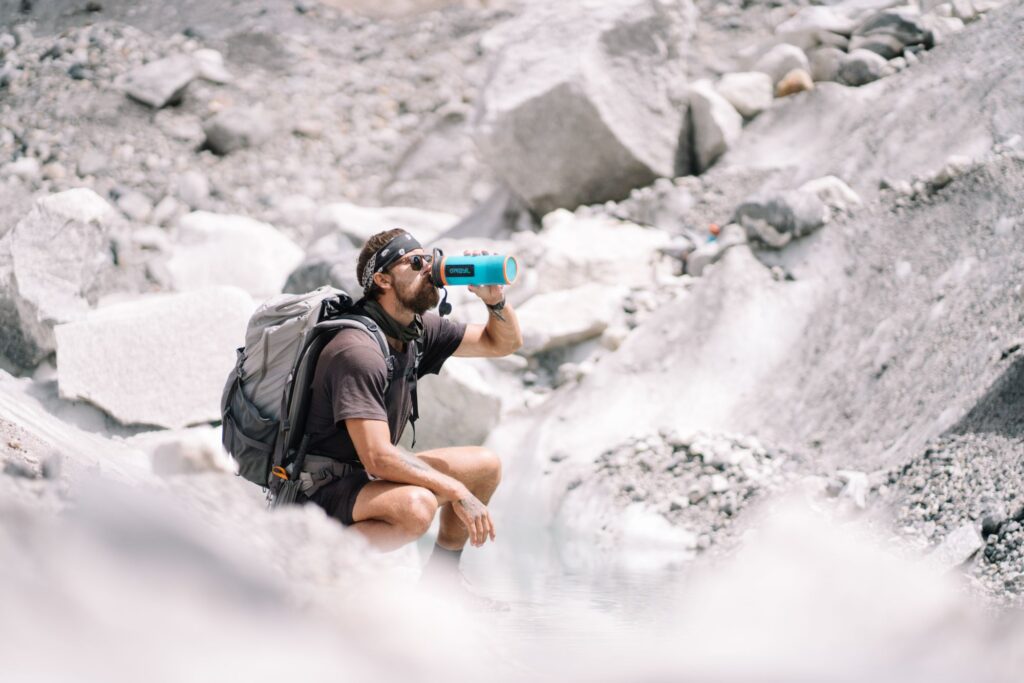
Our team are massive fans of this original flagship Grayl bottle. Between us, we can safely say we have “pushed” this bottle to the absolute limits. We’ve clipped it to the saddles of pack animals covering miles of the Karakoram, dropped it out of Jeeps on mountain roads in the Himalayas, and relied on it to purify water from sketchy taps in just about every climate imaginable.
Even though we clearly love this thing, we like to be as honest as possible when recommending gear, so here is our long-overdue, no-nonsense review of the original GRAYL Geopress water bottle purifier.
GRAYL Geopress Technical Specifications
Before we dive into how this bottle actually performs in the wild and how we use it on our expeditions, here are the numbers:
- Weight: 15.9 oz (450 g)
- Capacity: 24 oz (710 ml)
- Dimensions: 10.4″ (26.5 cm) tall x 3.4″ (8.6 cm) wide
- Flow Rate: 5 liters per minute (approx. 8 seconds per press)
- Cartridge Lifespan: Rated at 350 presses (250 Liters / 65 Gallons).
- Removes: 99.99% of viruses (Rotavirus, Norovirus, Hepatitis A), 99.9999% of bacteria (E. Coli, Salmonella), and 99.9% of protozoa (Giardia, Cryptosporidium).
- Filters: Microplastics, most chemicals, pesticides, and heavy metals.
First Impressions
Let’s get this out of the way early: no, this is not the lightest water bottle on the market. Comparing the 24 oz GRAYL Geopress to a standard bottle of the same volume, it’s a bit of a beast.
Ultralight thru-hikers, if you are used to sawing the handle off your toothbrush or drilling holes in your titanium spork to save a couple of grams, you can probably stop reading now.
But remember, this is not just a regular water bottle. It is a self-contained purification system that merges the filter and the storage vessel into one seamless unit. And, it’s very simple to use.
The first thing you’ll notice is that there are no separate bladder hoses to tangle, no batteries to charge, and you don’t have to hyperventilate trying to suck water through a clogged straw.
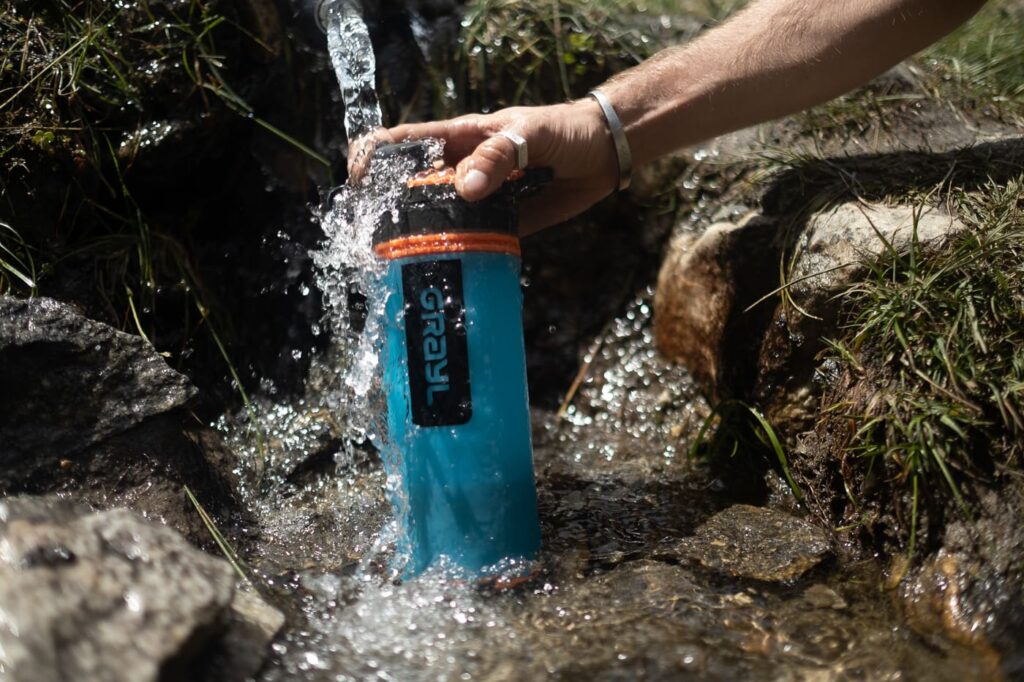
Pulling the Geopress out of the box, it looks just like a regular water bottle but feels substantial and surprisingly durable. Imagine the hardness of a Nalgene bottle, but much denser and more solid.
The top and side sections of the Polypropylene outer shell are wrapped in a grippy, rubberized material that feels like it was designed to be held by sweaty hands without slipping. When you set it down on a table, it lands with a dull, weighty thud, and since the bottom is lined with the same rubbery material, it won’t slide around or tip over very easily.
The lid features a heavy-duty three-finger plastic carry loop that feels tough as nails.
How Does the GRAYL Filter Work?
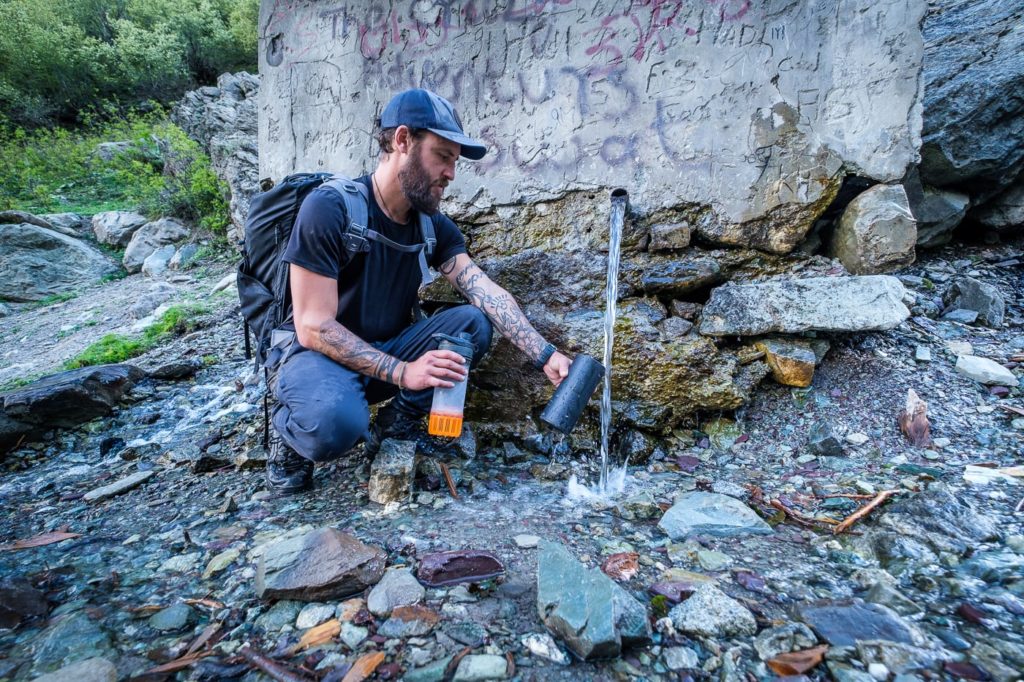
If you have ever made french press coffee in the morning, you already know how to use a GRAYL water bottle.
The system consists of three main parts:
- The Outer Cup: The vessel for the dirty water.
- The Inner Press: The vessel for the clean water.
- The Filter Cartridge: The screw-on “puck” attached to the bottom of the Inner Press.
The purifying process is refreshingly easy:
- Pull the Inner Press out of the Outer Cup to separate the two pieces.
- Fill the Outer Cup with water from any source (tap, stream, lake, or a puddle).
- Vent the cap (twist it loose half a turn to let air escape).
- Press the Inner Press down into the Outer Cup using your body weight (the cleaner the water, the easier the press, and vice versa).
As you push down, pressure forces dirty water through the GRAYL water filter cartridge. Inside that little puck, a mix of electro-adsorptive media and activated carbon gets to work. It physically traps viruses, bacteria, and protozoa while also absorbing chemicals, heavy metals, odors, and microplastics.
After about eight seconds, you get 24 ounces of safe, clean, purified drinking water.
Breaking Down the Geopress
We’ve relied on this bottle for years to keep us alive and hydrated in some of the most remote corners of the planet. Here is the honest breakdown of the bottle, why it’s arguably our favorite piece of expedition gear, and why we consider it to be almost perfect.
Effectiveness
When it comes to a filtered water bottle for traveling and adventure, this is the most important category. A water bottle can look cool, but if it doesn’t stop you from getting Giardia, what’s the point?
The good news is that a GRAYL water filter will stop protozoa like Giardia, as well as 99.9999% of bacteria.
However, what really distinguishes it from the competitors (like the Sawyer Squeeze or LifeStraw) is that it is a purifier, not just a filter.
This is a crucial distinction.
All of these standard filters are just as excellent at removing bacteria and protozoa. But, they’ll usually miss viruses like Hepatitis A, Rotavirus, and Norovirus because these are simply too small for hollow-fiber membranes to catch.
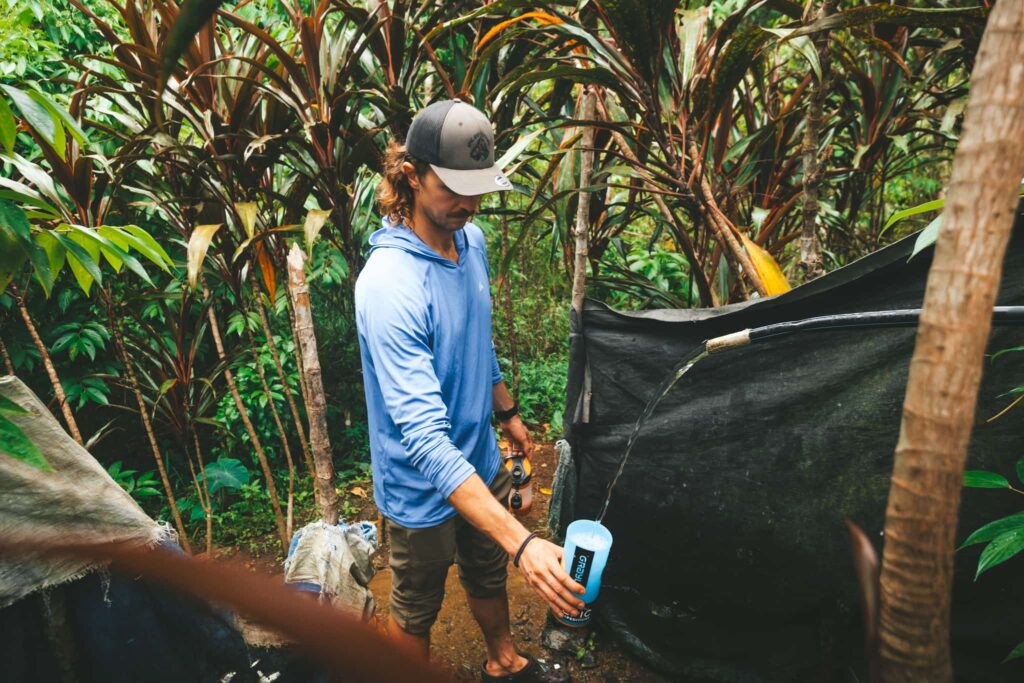
To trap a virus, you need a filter that is incredibly dense; so dense that you couldn’t possibly suck water through it with a straw, squeeze water through it with your hand, or rely on gravity alone.
GRAYL’s unique design allows you to use your full body weight to generate the pressure required to force water through a significantly more complex and dense cartridge. This design allows GRAYL to use the type of filters that rely on Ion Exchange and Electro-Adsorption technology. Without getting too technical, this means the filters act more like a magnet that physically grabs negatively charged viruses, rather than trying to scoop them through a net.
Does the GRAYL filter chemicals like fluoride? Yes, and most other heavy metals and microplastics too.
Ease of Use
While it’s neat to know that a filter will keep you safe, what we really love is how easy it is to use. After trying several water filtration devices in the past, the GRAYL Geopress is hands down the most intuitive and frictionless to use.
However, on a handful of past expeditions, we have seen instances where the water would “squirt” upward in a jet stream while pressing, usually hitting the presser right in the face.
While it provided endless entertainment for the rest of the group, it was less fun for the person getting a cold shower at altitude. To GRAYL’s credit, we believe this was an issue with a limited run of earlier cartridges that has now been resolved, as we haven’t seen this happen with any new cartridges we’ve bought in the last two years.
Durability & Longevity
The bottle itself is seriously tough. The outer shell is resilient, the rubber grip refuses to peel even when left in the sun for days, and the lid loop is strong enough to carabiner onto a horse saddle without fear of it snapping off on the Mongolian steppe.
However, the lifespan of the filter cartridge is a different case.
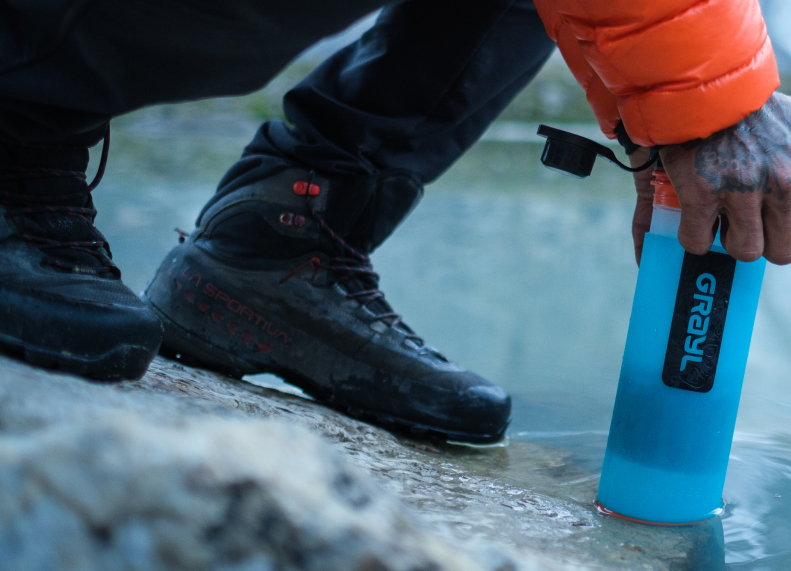
GRAYL claims a lifespan of around 350 presses (250 Liters). If you are using this as your daily bottle while traveling, filtering water from the sink of every hotel, hostel, and airport, you will burn through those 350 presses faster than you think.
That said, the longevity of the cartridge ultimately comes down to the quality of the water you are filtering. In the past, we have seen cartridges last much longer than the recommended 350 presses when filtering relatively clear water.
Don’t worry, you will know you are due for a change because water will become much more difficult to press.
However, this goes both ways. We have also seen practically new cartridges die in less than a week.
On one of our K2 Base Camp expeditions, a client wasn’t very careful about selecting streams and was filtering very thick, silty glacial water straight from the Baltoro. The sheer amount of sediment clogged the filter media pretty quickly, and the bottle became impossibly hard to press after just a few days.
Furthermore, if you are hiking in the cold, you should avoid filling the GRAYL Geopress with boiling water to use as a sleeping bag warmer, as the extreme heat will damage the cartridge media. Similarly, if you allow the wet filter to freeze overnight, the water inside the fibers can expand and render it useless.
Packability
Weight and size are what most people have a problem with, and we understand that. Minimizing pack weight is crucial, and your gear should fight for every gram, especially when you are hiking with a water bottle filter up a mountain or hauling it across a glacier.
At 15.9 oz (450g), or practically a pound, we can’t argue that it’s not one of the heaviest filtering solutions on the market. It is also bulky.
But here is the counter-argument.
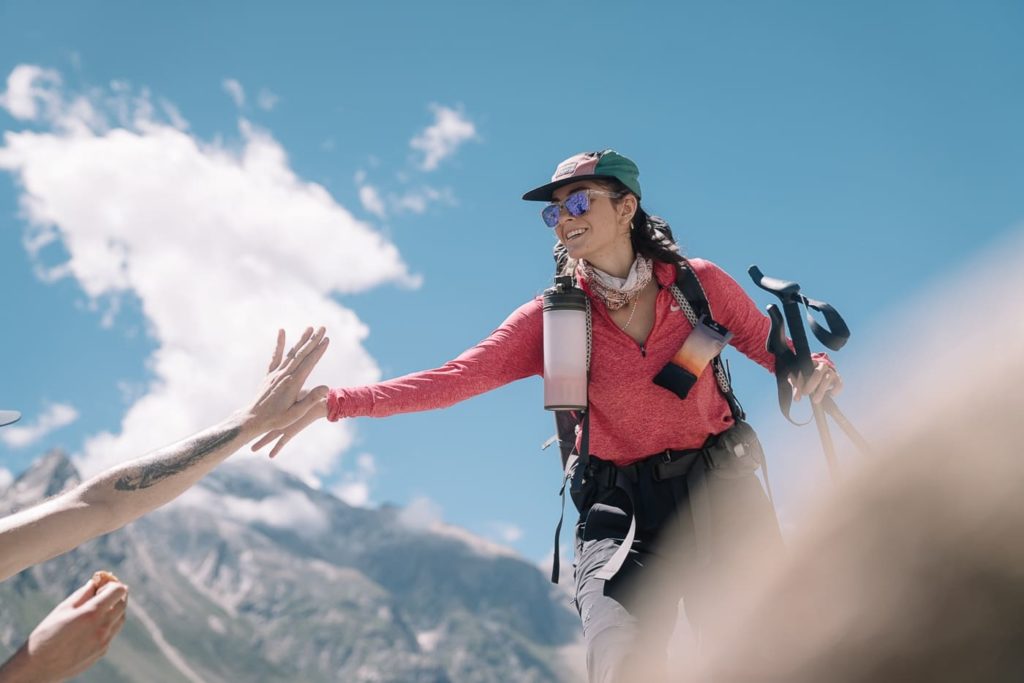
All in all, what makes the bulk forgivable is that you can actually store your purified water inside it. This is a game-changer. With many other filters, you need a “dirty” bag and a “clean” bottle. With the Geopress, the filter is the bottle.
This means you don’t need to carry several extra Nalgene bottles or feel forced to chug (or suck) down 24 ounces of water on the spot just to hydrate. You press it, cap it, and carry it. When you look at it that way, the weight penalty isn’t actually that bad, in our humble opinion of actually using this gear day in and day out.
And most importantly, does it pass the “backpack water bottle pocket” test? Yes, we haven’t found a hiking backpack that won’t accommodate the GRAYL Geopress.
Pros & Cons of the GRAYL Geopress
We get it, you’re busy looking for epic hiking gadgets to get you hyped for your next trip. For the skim readers, here is the cheat sheet of what we discussed above.
Pros
- It is a purifier: It doesn’t just filter bacteria and protozoa, it removes viruses (Hepatitis A, Rotavirus, Norovirus) as well.
- Very easy to use: No hoses to tangle, no batteries to charge, and no “dirty bags” to carry.
- Fast flow rate: 24oz of clean water in about 8 seconds.
- Store your clean water: The Geopress allows you to carry purified water with you.
- Extremely durable: You can drop it, kick it, and abuse it. This thing will survive.
Cons
- Weight & bulk: It weighs a pound (15.9 oz) essentially and takes up much more room than a standard 24 oz bottle (though still fits in a standard backpack water bottle pocket)
- Cartridge cost: Replacement filters are not cheap, and if you travel frequently, the cost can add up.
- Filter sensitivity: Abuse the bottle but not the cartridge. If you filter muddy or silty glacial water without scrutiny, you will clog the cartridge faster than the rated 350 presses. If you pour in boiling water or let it freeze, you’ll also ruin the filter.
Situations Where the GRAYL Thrives
We don’t review gear in a lab; we drag it halfway across the world and put it to the real test. Over the years, the Geopress has become the one non-negotiable item on our packing lists. Besides the obvious trailside stream, here are some unique instances where we’ve found the GRAYL Geopress to come in handy.
The Airport Hack
Before you even hit the trail, the Geopress starts to pay for itself in transit. We all know the pain of dumping our water at security and then staring at a $7 price tag for a new bottle at the gate.
With a GRAYL, you can fill up from any bathroom tap and not bat an eyelid.
Livestock-Heavy Trails

On our Kyrgyzstan expeditions, water is everywhere. Picture crystal clear streams flowing through almost every valley. But looks can be deceiving. These valleys are also home to thousands of horses, sheep, and yaks that graze and do their business right next to the water source.
In these environments, a standard filter isn’t enough. Having a Geopress means you can scoop water from a stream near a yurt camp and drink it immediately without worrying about the invisible runoff from the livestock upstream.
Teahouses and Mountain Huts
We willingly trust our lives to our mountain guides. But trusting that a busy teahouse kitchen actually brought that glacier water to a rolling boil for three minutes? As long as it’s cooled, we always give it a press just in case. (One former Epic guide got a nasty case of Giardia in Nepal in this very situation, before GRAYLs were available, of course.)
Remote Expeditions
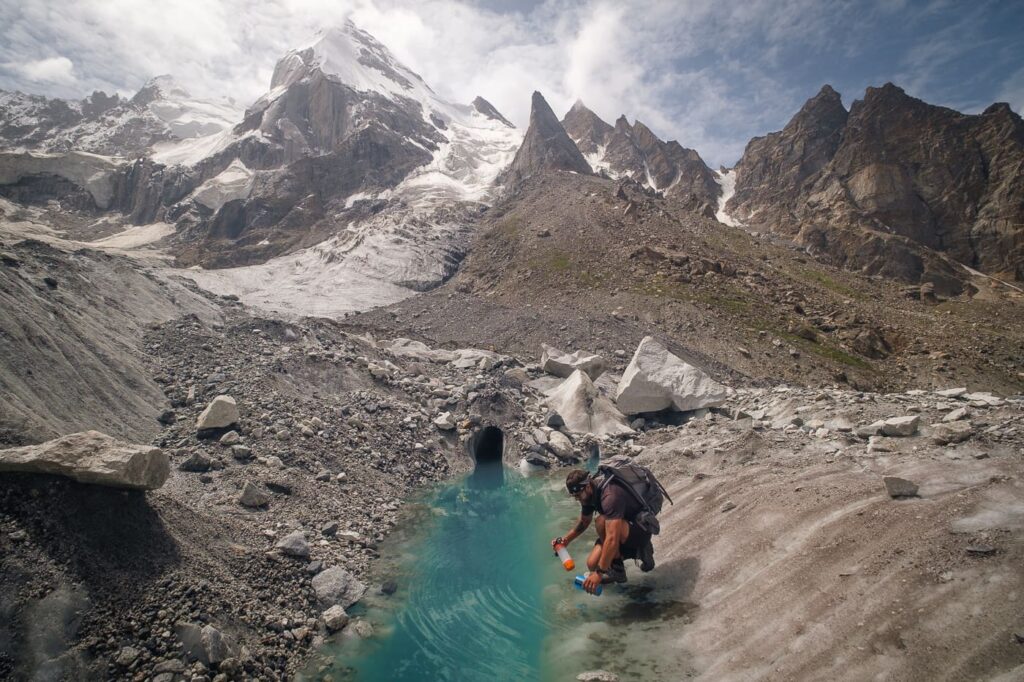
We lead expeditions to some of the world’s most remote regions. Naturally, a common question we get from prospective clients are things like “is Pakistan safe?“
The truth is, we believe among the most dangerous things for travelers in Pakistan is actually the water. And this is true for many remote areas on the planet.
In regions like the Karakoram or the Andes, the local microbiome is vastly different from what your gut is used to. A single sip of contaminated water can end your trip before it even begins. Using a Geopress here is your primary defense against the one thing most likely to send you to the hospital.
GRAYL vs. The Competition
Tales of what now feel like a bygone era tell of trekkers popping purification tablets (chlorine or iodine) to purify their water. While some old-school trekkers still swear by them, I think we can now all agree that drinking water that tastes like a swimming pool for three weeks is straight up miserable, not to mention a recipe for disaster for your gut biome.
And trust us, relying on probiotics alone to cancel out the chlorine is a losing battle.
Thankfully, the industry has evolved, and with it, plenty of capable water filters have hit the shelves of REI. Here is how the Geopress stacks up against the best of the rest.
GRAYL vs. Sawyer Systems
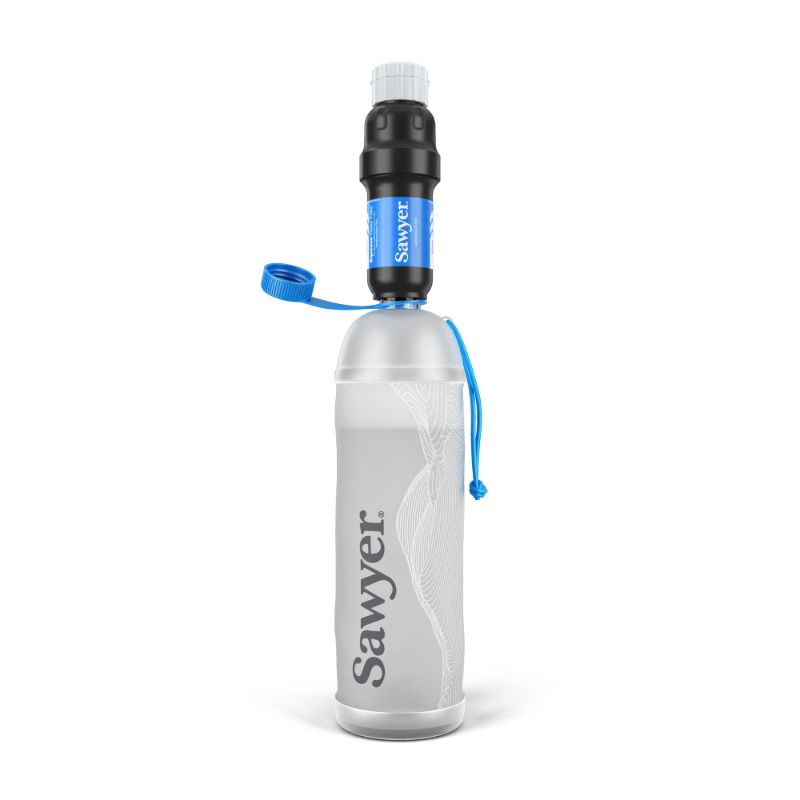
The Sawyer ecosystem (including the Squeeze, Mini, and Micro) is the darling of the ultralight hiking community. Just join any thru-hike Facebook Group or other ultralight online community, and you’ll see it recommended in almost every gear roundup and discussion.
This system is vastly different to the GRAYL Geopress and works using hollow-fiber membranes packed into tiny, ultralight filters that are very versatile. You can screw these filters onto a store-bought bottle and drink directly from the nozzle, rig it “inline” into your CamelBak hose, or set it up as a high-volume gravity system.
The popular Sawyer Squeeze lasts a very long time and weighs just 3 ounces.
So why do we still consider the Geopress the best backpacking water bottle and filtration solution?
The answer is simplicity and protection. The Sawyer is a filter, not a purifier. This is the dealbreaker for us. While the Sawyer is fantastic for the mountains of Colorado or the French Alps, it leaves a dangerous gap in your protection if you are traveling to wilderness areas in Pakistan, Peru, or Nepal.
Furthermore, dealing with dirty water bags, backflushing syringes, and complex gravity rigging is a hassle we prefer to avoid when we just want a quick drink. Simply put, we prefer the Geopress because it’s faster, easier to use, and crucially, offers the best purification available right now.
GRAYL vs LifeStraw
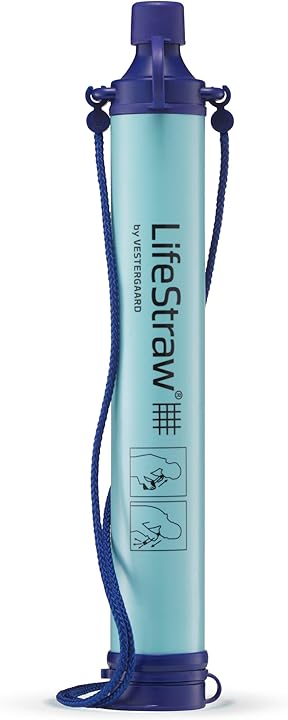
The original LifeStraw is iconic. That famous marketing image of the cool survival dude sucking water from a puddle is likely the first thing that pops into your head when talking about outdoor water filters.
But while the LifeStraw did make some waves when it made its debut in the outdoor community around 2012, for reliable travel and trekking use today, the LifeStraw just doesn’t really stack up.
The problem is pretty obvious if you’ve ever used one for an extended period.
While neat in theory, to use it, you have to lay down on your belly in the mud to drink from a stream, or awkwardly cup dirty water into a mug to suck it out. In extension, the design forces you to be either physically tethered to your dirty water source, or to carry around dirty water.
The worst part, once you stop sucking, you have no water. Unless you’re spitting it back into your Nalgene (gross), you can’t throw it in your pack for the hike up the pass, and you certainly can’t use it to brew a mess-tent coffee.
The reason we love the Geopress is that it works on the opposite principle. You press it once, and you have 24oz of potable water that is separated from the dirty source. You can drink it now, share it with others, or screw the cap on and save it for later.
Where to Buy the GRAYL
The GRAYL Geopress retails for $99.95 USD. You can buy it directly from GRAYL’s website with worldwide shipping, or from REI for the same price.
Final Verdict: Is the GRAYL Worth It?
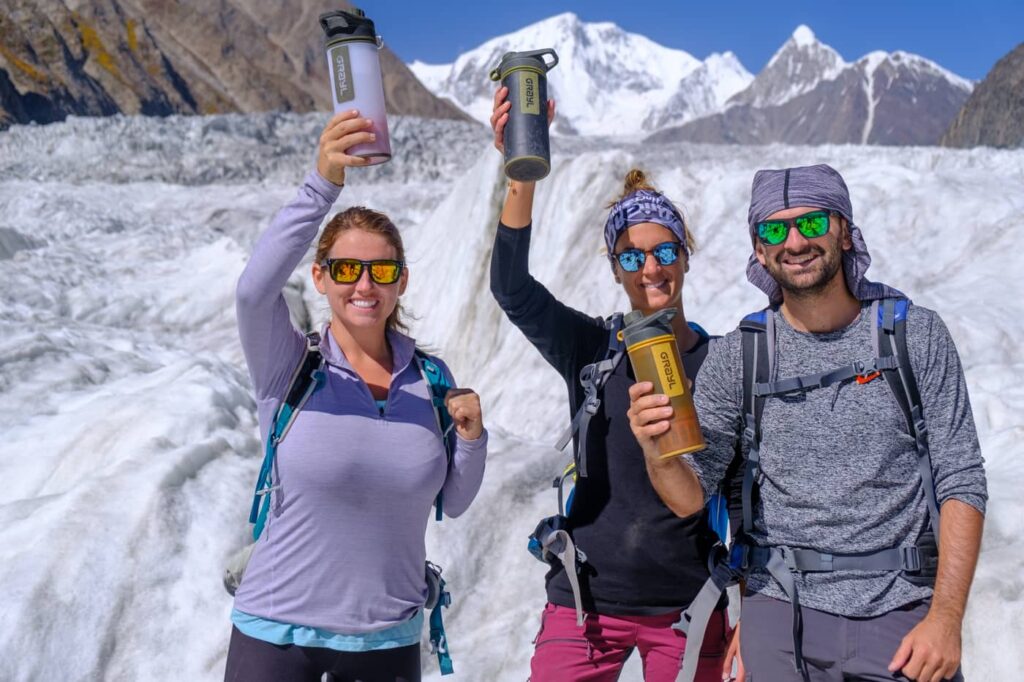
Let’s be real for a second. Spending close to $100 on a water bottle feels steep. And for that price, it better be good.
Is it perfect? No, but it’s very, very close.
Has it earned its place as a permanent piece of trekking gear on all of our expeditions? Without a doubt.
For the serious adventure traveler, our conclusion is that the GRAYL Geopress is the best water filtered bottle money can buy.
That said, if you are strictly a weekend warrior hiking in the US or Europe, where the water is relatively safe, the Geopress is likely overkill, and you can save a few dollars and weight with a Sawyer Squeeze, if you don’t mind the extra setup process, that is.
Additional FAQ About the Geopress
While there are small design changes like the lack of a silicone tab for the lid, the main difference between the Geopress and the Ultrapress is size and capacity. The Geopress holds 24 oz (710ml) and weighs around 15.9 oz (450 g). The Ultrapress is slimmer, lighter at 10.9 oz (309 g) and only holds 16.9 oz (500ml).
We clean the unit as recommended by GRAYL. We start by separating the Inner Press, Outer Cup, and Lid. We then wash the plastic parts (both the cup and lid) with warm, soapy water just like any other dish. However, the cartridge itself should only be rinsed with clean water. If you get soap inside the filter media, you will ruin it permanently.
When storing the bottle for a long time between uses, we like to dry the cartridge out to avoid mildew. We do this by “dry pressing” it through the cup several times and leaving it on a countertop to air dry.
No. The Geopress is designed for freshwater only. It will not desalinate ocean water. If you are stranded on a life raft, this bottle will not save you.
While it used to be a solid no, you now can, with a catch.
In 2023, GRAYL released a new “One-Way Valve” cartridge. If you have this specific valve installed, you can add electrolytes directly into the clean water after you have pressed it (the important part). The valve prevents the sugary water from flowing back down into the filter and clogging it.
If you have an older cartridge, do not do this as it will seep back into the filter media and can ruin the cartridge.